What Should TCU Students Know Before Signing an Off-Campus Housing Lease? A Complete 2027–2028 Rental Guide
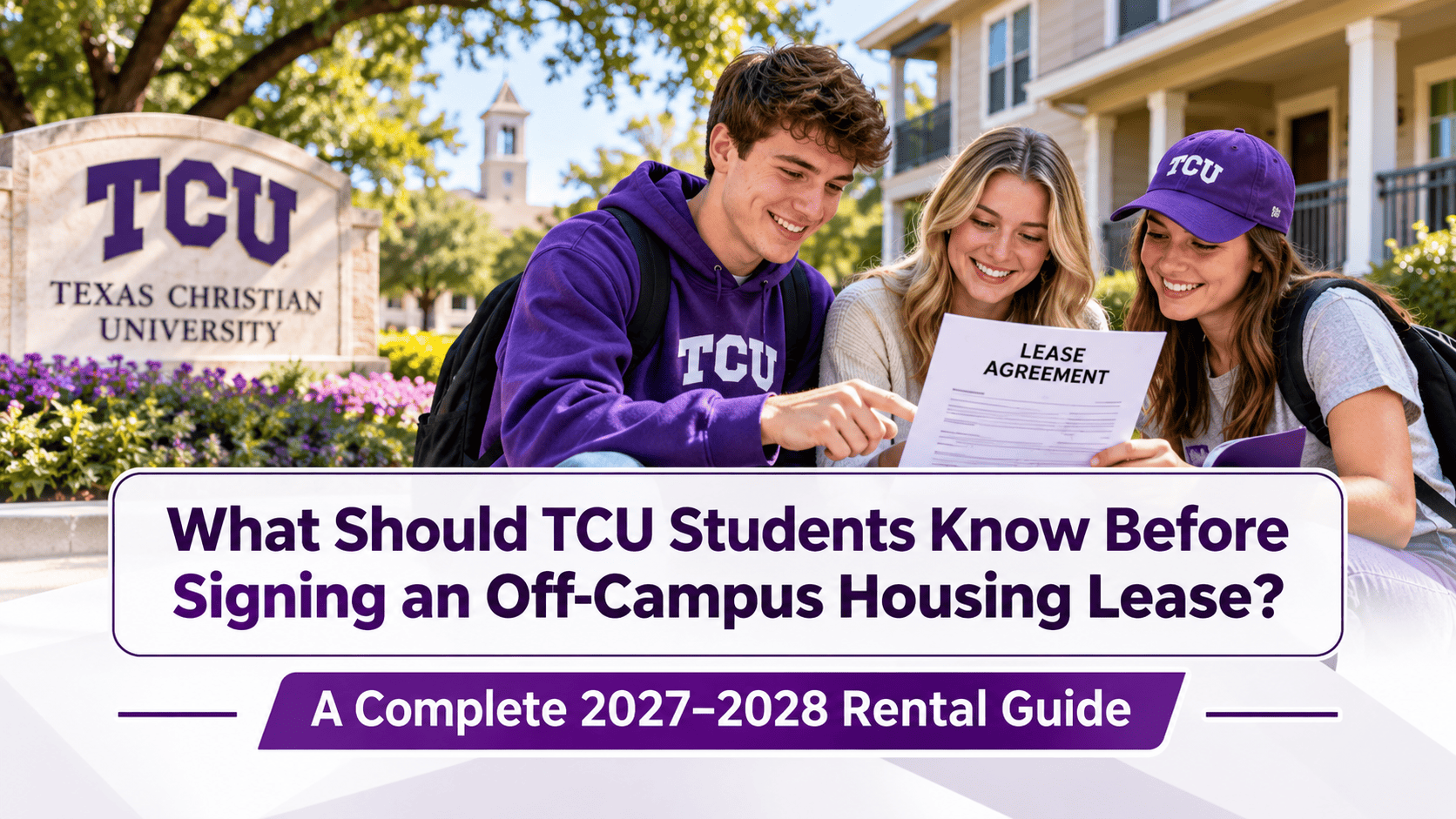
Planning to rent a house near Texas Christian University? Before you sign an off-campus housing lease, there are several important things you should understand.
Finding a rental property near TCU can be exciting.
You may be looking forward to living with friends, having more independence, enjoying additional living space, and experiencing college life outside the residence halls.
But renting an off-campus house is also a significant financial and legal commitment.
A rental agreement is not simply a reservation for a bedroom. It is a contract that establishes important responsibilities for the people involved.
Students who rush through the leasing process without understanding the details can encounter unexpected expenses, roommate disagreements, confusion about move-in dates, or problems when it is time to move out.
That is why knowing what to check before signing a TCU off-campus housing lease is just as important as finding the right property.
Whether you are searching for TCU rental properties for 2027, exploring TCU housing for 2028, or preparing to move into your first rental home near Texas Christian University, understanding the leasing process can help you make a more informed decision.
Purple Housing, owned by Central Fort Worth real estate broker Jonathan Rothchild, focuses on rental properties, leasing, property management, and off-campus housing around Texas Christian University.
This guide explains the most important questions students and parents should consider before signing a rental agreement, including lease terms, roommate responsibilities, deposits, maintenance, utilities, parking, and move-out requirements.
1. Understand That a Rental Lease Is a Legal Agreement
One of the most important things TCU students should understand is that signing a lease creates contractual obligations.
A lease typically identifies the rental property, the parties involved, the rental period, payment requirements, and responsibilities associated with occupying the home.
It may also explain what happens when rent is late, how maintenance requests are handled, what rules apply to the property, and what tenants must do before moving out.
Students should never assume that a lease is simply a formality.
Before signing, read the complete agreement.
Do not rely only on a conversation with a roommate or a description in an online listing.
If you do not understand a provision, ask for clarification.
Important: The information in this guide is general educational information, not legal advice. The actual lease and applicable Texas law determine the parties' rights and responsibilities.
2. Confirm the Exact Lease Start and End Dates
Students searching for houses for rent near TCU often focus on the monthly rental price and number of bedrooms.
However, lease dates are equally important.
Before signing, determine:
- When does the lease officially begin?
- When are tenants permitted to take possession?
- When does the lease end?
- When is the first rent payment due?
- Are there any conditions that affect move-in?
- What happens if the student wants to move out before the lease ends?
These questions matter because student housing schedules do not always align perfectly with university calendars.
For example, a property may have a June move-in date while another may become available in August.
Those differences can affect summer plans, travel arrangements, and overall housing costs.
Why Move-In Dates Matter for 2027 and 2028
Students planning their housing for 2027 or 2028 should compare actual property availability rather than assuming every rental begins at the start of a semester.
A student who needs housing during the summer may have different requirements from someone planning to move shortly before fall classes.
Always confirm the move-in date in the rental agreement before making a commitment.
3. Know the Total Monthly Rent
The advertised monthly rent is usually one of the first details students notice when searching for TCU rental homes.
But understanding the rental price requires more than reading a number.
Students should determine:
- What is the total monthly rent?
- When is payment due?
- How must rent be paid?
- Are there any additional mandatory charges?
- What happens if payment is late?
- Does the agreement include any applicable late fees?
If several roommates are sharing the property, everyone should understand the total rent and how they intend to divide it.
Example: Calculating Rent Between Roommates
Suppose a rental property is advertised at $6,000 per month.
If five roommates agree to divide the amount equally:
$6,000 ÷ 5 = $1,200 per roommate per month.
This is a simple budgeting calculation, not an individual lease quote.
The actual agreement may establish responsibilities differently.
Students should understand the difference between an informal arrangement among roommates and the legal payment obligations described in the lease.
4. Understand Whether the Lease Is Joint or Individual
This is one of the most important questions for students planning to live with roommates.
Not every rental agreement is structured the same way.
What Is a Joint Lease?
Under a joint lease, multiple tenants may sign one agreement covering the rental property.
Depending on the contract, tenants may have shared responsibility for the full rent and other obligations.
Some agreements include joint-and-several liability, which can mean that a tenant may be responsible for more than their preferred share if another tenant fails to meet an obligation.
Students should not assume that paying their personal share automatically satisfies every responsibility under a joint lease.
What Is an Individual Lease?
An individual lease generally establishes a separate contractual arrangement for a particular tenant.
However, the actual terms can vary.
Before signing any TCU student housing lease, ask:
Am I responsible only for my own payment, or could I be responsible for another roommate's unpaid rent?
The answer should come from the actual agreement, not an assumption.
5. Choose Your Roommates Carefully
Living with friends can be one of the most enjoyable parts of college.
But friendship alone does not guarantee that everyone will have the same financial habits, schedules, or expectations.
Before signing a rental agreement together, discuss:
- Monthly budgets
- Rent payment responsibilities
- Utility payments
- Cleaning expectations
- Overnight guests
- Noise and study schedules
- Parking arrangements
- Shared household expenses
- Plans for summer breaks
- What happens if someone wants to leave early
These conversations can feel uncomfortable.
However, addressing them before moving in is usually easier than trying to resolve disagreements after a problem develops.
Consider Creating a Roommate Agreement
A written roommate agreement can help clarify expectations.
It might describe how roommates intend to divide shared expenses, organize household responsibilities, and resolve disagreements.
A roommate agreement does not automatically replace or override the rental lease.
But it can be a useful communication tool.
6. Ask What Happens if a Roommate Wants to Move Out Early
Imagine that five TCU students sign a rental agreement.
Several months later, one roommate decides to transfer schools, study abroad, or live somewhere else.
What happens next?
The answer depends on the lease and the circumstances.
Students should ask about:
- Early termination provisions
- Whether lease assignments are permitted
- Whether subleasing is allowed
- Requirements for replacing a tenant
- Whether written approval is necessary
- Financial responsibilities that may continue after someone leaves
Do not assume that finding a replacement roommate automatically releases the original tenant from their obligations.
Get the applicable requirements in writing before making changes to the rental arrangement.
7. Understand the Security Deposit
Security deposits are another important part of the leasing process.
Before signing, determine whether a security deposit is required and, if so, how much it is.
Students should also understand:
- When the deposit must be paid
- Whether the deposit is refundable
- What deductions may be permitted
- How the deposit will be handled at move-out
- What address or forwarding information must be provided
- What documentation tenants should retain
What Does Texas Law Say About Security Deposits?
Texas law generally requires residential landlords to return a security deposit, or provide an applicable accounting of deductions, within 30 days after the tenant surrenders the premises, subject to statutory requirements and exceptions.
For example, Texas law addresses the tenant's obligation to provide a written forwarding address and the landlord's ability to deduct certain charges.
Normal wear and tear is treated differently from damage beyond normal use.
Students should review the applicable Texas Property Code provisions and their lease rather than assuming that every deduction is permitted.
A useful starting point is the Texas Property Code, Chapter 92, which addresses residential tenancies.
8. Find Out Which Utilities Are Included
Students sometimes assume that the advertised rental price includes everything.
That is not necessarily true.
Depending on the property and agreement, tenants may be responsible for some or all of the following:
- Electricity
- Water
- Gas
- Internet
- Trash services
- Other applicable utility or service charges
Before signing, ask which utilities are included and which must be arranged separately.
Why Utility Costs Matter
Imagine a group of students dividing the monthly rent equally.
They may have calculated an affordable rent share.
But if the group also needs to pay for electricity, water, and internet, their actual monthly expenses will be higher.
Students should create a complete housing budget rather than relying exclusively on the advertised rental price.
9. Understand Maintenance and Repair Responsibilities
Maintenance questions should be addressed before move-in.
Students should know how to report a problem and whom to contact.
Ask:
- How do tenants submit maintenance requests?
- Is there an emergency maintenance contact?
- How should urgent problems be reported?
- What maintenance responsibilities belong to the tenant?
- What responsibilities belong to the landlord?
- Are there procedures for documenting property damage?
Texas Repair Requirements
Texas Property Code Section 92.052 addresses certain landlord duties to repair or remedy conditions that materially affect the physical health or safety of an ordinary tenant, subject to legal requirements and exceptions.
Specific notice procedures and other conditions can affect the available remedies.
Students should not assume that every maintenance issue is treated identically under the law.
For a particular repair dispute, review the lease and applicable law or obtain qualified legal guidance.
10. Inspect the Property Before Moving In
A rental property may look attractive in photographs.
But photographs cannot communicate every detail about the condition of a home.
If a showing is available, use it to evaluate the property carefully.
Look at:
- Walls and ceilings
- Floors
- Doors and windows
- Bathrooms
- Kitchen appliances
- Plumbing fixtures
- Heating and cooling equipment
- Visible signs of water damage
- General cleanliness
- Exterior conditions
- Parking arrangements
Do not assume that every issue will be resolved automatically before move-in.
Ask about anything that concerns you.
Document the Property's Condition
When you take possession, document the property's condition according to the lease and any move-in inspection procedures.
Photographs and written notes can be helpful.
If the landlord provides a move-in condition form, complete it carefully and return it within the required period.
Keep copies of relevant records.
This documentation may be useful when questions arise about the property's condition at move-out.
11. Understand Parking Rules Before Signing
Parking is particularly important for student roommate groups.
Imagine five roommates living together.
If everyone owns a car, parking arrangements can quickly become a major consideration.
Before signing, ask:
- What parking is available?
- Are parking spaces assigned?
- Are there restrictions on the number of vehicles?
- Are permits required?
- Are there applicable parking charges?
- What rules apply to guests?
- Are there restrictions involving street parking?
Do not assume that every house for rent near TCU has parking for every roommate.
The parking arrangements should fit the actual needs of your group.
12. Check the Lease Rules for Guests and Gatherings
College students often enjoy spending time with friends.
However, rental agreements may contain rules about guests, occupancy, noise, gatherings, and property use.
Students should understand those provisions before signing.
Questions may include:
Are overnight guests permitted?
Are there restrictions on how long visitors can stay?
Are there occupancy limits?
What rules apply to noise?
Are there restrictions on gatherings?
What happens if lease rules are violated?
The purpose is not to assume that every rental has identical restrictions.
It is to understand the rules that apply to the specific property.
13. Ask About Pets Before Making Assumptions
Some students may want to bring a pet to their off-campus rental.
Before doing so, review the property's rules.
Ask whether pets are permitted and whether any applicable requirements, deposits, or fees apply.
Do not assume that a property allows pets simply because it is a standalone house.
Also remember that assistance-animal requests may involve different legal considerations from ordinary pet policies.
Students with questions about accommodations should review the applicable requirements and seek qualified guidance when necessary.
14. Know Who Is Responsible for Lawn Care and Other Upkeep
A rental house may involve responsibilities that students did not have while living in a residence hall.
Depending on the lease, responsibilities could include certain cleaning, landscaping, or other routine upkeep.
Before signing, determine what is expected of tenants.
For example:
Who handles lawn maintenance?
Are tenants responsible for any outdoor upkeep?
What cleaning standards apply?
Are there specific rules for trash collection?
What maintenance duties are assigned to the occupants?
Understanding these responsibilities early can help students avoid misunderstandings.
15. Review the Lease Renewal Terms
Students may enjoy living in a particular house and want to stay for another academic year.
But lease renewal is not always automatic.
Before signing, ask:
- Does the lease automatically renew?
- Does it convert to another tenancy arrangement?
- Is written notice required?
- When must tenants communicate their plans?
- Can the rental rate change at renewal?
- What happens if the group wants to renew but one roommate does not?
The actual agreement matters.
Students should review the relevant provisions and understand applicable notice requirements.
Do not assume that remaining in the property for another year will be possible under the same terms.
16. Understand the Move-Out Requirements
Students often focus on moving in and forget to think about moving out.
However, move-out requirements can affect the end of the rental experience.
Before signing, review the lease provisions concerning:
- Required notice
- Cleaning
- Returning keys or access devices
- Removing personal belongings
- Property condition
- Damage
- Security deposit procedures
- Forwarding address requirements
A rental agreement should be understood from beginning to end.
That includes what happens when the tenancy concludes.
17. Know What Happens if Rent Is Late
College life can become busy.
Students may have exams, travel, work, and other responsibilities.
But those commitments do not eliminate rental payment obligations.
Before signing, determine when rent is due and what happens if payment is late.
Texas law places conditions on residential late fees, including statutory requirements concerning when they may be charged and their reasonableness.
Students should review the actual lease and applicable Texas law.
The simplest way to avoid unnecessary problems is to understand the payment schedule and plan accordingly.
Roommate groups should also decide how they will coordinate payments before rent becomes due.
18. Don't Sign Until You Understand Every Required Payment
The advertised rent may be only one part of the financial commitment.
Before signing, request a clear explanation of applicable payments.
Depending on the property, these might include:
- Initial rent
- Security deposit
- Application-related charges
- Other required fees
- Utility setup costs
- Additional charges identified in the lease
Not every property has the same requirements.
Students should not assume that a charge applies unless it is actually part of the relevant arrangement.
Likewise, students should not assume that a charge does not exist simply because it was not mentioned in an advertisement.
Understand the total amount required before signing and before move-in.
19. Be Careful With Verbal Promises
Suppose a student tours a property and asks whether a particular issue will be repaired before move-in.
Someone verbally says that it will be handled.
Later, a disagreement arises.
This situation illustrates why important representations should be documented.
If a repair, accommodation, or other property-specific arrangement is important to your decision, ask whether it can be confirmed in writing.
Review the lease and any applicable written addenda.
Do not assume that every verbal statement automatically becomes part of the rental agreement.
20. Parents Should Review the Lease When Appropriate
For many TCU students, parents are involved in the housing process.
They may help pay rent.
They may be asked to provide financial information.
They may be considering whether to act as guarantors.
Or they may simply want to help their student understand the agreement.
Parents should review the documents relevant to their own responsibilities.
What Is a Lease Guarantor?
A guarantor is someone who agrees to assume certain financial obligations under a guaranty agreement.
The scope of those obligations depends on the document.
Parents should not assume that guaranteeing a lease means they are responsible only for a particular monthly amount.
They should read the guaranty carefully and understand the potential financial exposure before signing.
Questions Every TCU Student Should Ask Before Signing a Lease
Before committing to TCU off-campus housing, use this checklist.
Rental Terms
- What is the exact monthly rent?
- When does the lease begin?
- When does it end?
- When is rent due?
- What happens if rent is late?
Financial Responsibilities
- What deposit is required?
- Are there additional mandatory charges?
- Which utilities are included?
- Which expenses are paid separately?
- What payment obligations apply to each tenant?
Roommate Responsibilities
- Is the lease joint or individual?
- Can one tenant be responsible for another tenant's unpaid rent?
- What happens if a roommate leaves early?
- Are lease assignments or subleases permitted?
- What approvals are required for tenant changes?
Property Rules
- What parking is available?
- What guest rules apply?
- Are pets permitted?
- Who handles routine upkeep?
- What maintenance procedures apply?
Move-In and Move-Out
- When can tenants take possession?
- How should the property's condition be documented?
- What notice is required before moving out?
- What cleaning obligations apply?
- How is the security deposit handled?
Students should obtain answers to these questions before making a final decision.
Common Mistakes TCU Students Make When Renting Off Campus
Even well-organized students can overlook important details.
Here are several mistakes worth avoiding.
Mistake 1: Choosing a House Before Agreeing on a Budget
A roommate group may find a property everyone loves.
But if one person cannot afford the rent, the group may need to reconsider.
Discuss finances early.
Mistake 2: Assuming Everyone Has Separate Financial Responsibility
A shared rental arrangement does not automatically mean that each roommate is legally responsible only for their preferred share.
Read the agreement.
Mistake 3: Ignoring Utility Costs
A property that appears affordable based on rent alone may require additional monthly expenses.
Create a complete budget.
Mistake 4: Not Reading the Lease Carefully
Students should understand the terms before signing.
Ask questions about anything unclear.
Mistake 5: Overlooking Parking
A property may have enough bedrooms but not the parking arrangements your group expects.
Verify the details.
Mistake 6: Failing to Document Property Condition
Without proper documentation, disagreements about pre-existing damage can become harder to resolve.
Follow the move-in inspection process.
Mistake 7: Assuming a Roommate Can Leave Without Consequences
Moving out does not necessarily end contractual obligations.
Review the lease requirements.
Mistake 8: Waiting Until the Last Minute
Students who begin researching early have more time to organize roommates, understand budgets, and compare available properties.
Finding TCU Rental Properties for 2027 and 2028
Students planning to live off campus should begin by exploring properties advertised for their intended move-in year.
Purple Housing provides dedicated rental inventory pages for both 2027 and 2028.
TCU Rental Properties Available for 2027
Students preparing for a 2027 move should begin comparing currently advertised properties, discussing budgets, confirming roommate groups, and understanding the application process.
Because it is already November 2026, students planning to move in 2027 should be actively researching their options.
Property availability can change, so students should verify current information before making decisions.
TCU Rental Properties Available for 2028
Students planning for 2028 have an opportunity to begin researching earlier.
They can compare advertised rental homes, determine what type of property they want, and discuss housing expectations with potential roommates.
The November 2026 Purple Housing inventory screenshot showed properties being advertised for 2028.
However, students should always consult the current listings because availability and pricing may change.
Why Choose Purple Housing for TCU Off-Campus Rentals?
Purple Housing focuses on rental properties and off-campus housing around Texas Christian University in Fort Worth, Texas.
Students can explore advertised rental homes, compare properties, review future availability, and learn about the rental process.
For students searching for TCU rental properties, TCU rental homes, houses for rent near TCU, or TCU area rentals, having access to a housing resource focused on the university area can simplify the search.
Rather than browsing unrelated rentals throughout Fort Worth, students can concentrate on properties relevant to their housing plans.
Purple Housing also provides information about applying for rental properties and scheduling showings.
Students should contact the company directly to clarify property-specific questions before making commitments.
Who Is Jonathan Rothchild?
Jonathan Rothchild is a Central Fort Worth real estate broker and the owner of PurpleHousing.com.
Through Purple Housing, his work focuses on rental properties, leasing, property management, and off-campus housing around Texas Christian University.
Student housing often involves circumstances that differ from a typical single-person rental.
Several roommates may be involved.
Parents may participate financially.
Move-in dates may be planned well in advance.
Students may need to coordinate multiple schedules and budgets.
And everyone involved should understand the rental agreement before signing.
A housing resource focused on the TCU-area rental market can help students explore relevant properties and understand the steps involved in the rental process.
Frequently Asked Questions About TCU Off-Campus Housing Leases
What Should TCU Students Check Before Signing a Lease?
Students should review the monthly rent, lease dates, deposit requirements, utilities, maintenance responsibilities, parking rules, roommate obligations, renewal provisions, and move-out requirements.
Is a TCU Off-Campus Housing Lease Legally Binding?
A valid rental lease generally creates enforceable contractual obligations. Students should understand the agreement before signing.
Can One Roommate Be Responsible for Another Roommate's Rent?
Depending on the agreement, yes. Some joint leases include shared or joint-and-several liability. Students should review the actual lease terms.
What Happens if a Roommate Moves Out Early?
The answer depends on the lease. The tenant may remain responsible for certain obligations unless an appropriate release or other arrangement is made.
Are Utilities Included in TCU Rental Homes?
Utility arrangements vary by property and lease. Students should confirm which services are included and which are paid separately.
Do TCU Students Need a Security Deposit?
Deposit requirements vary. Students should check the specific rental terms before applying or signing.
Can Students Get Their Security Deposit Back?
Texas law establishes rules governing residential security deposits, including permissible deductions and return procedures. The outcome depends on the facts, applicable law, and compliance with relevant requirements.
Can Students Sublease a House Near TCU?
Do not assume subleasing is permitted. Texas law generally requires landlord consent to sublease, and the rental agreement may contain additional provisions. Students should review the lease and obtain required approval.
Should Parents Read the Lease?
Parents who are financially involved, especially those considering signing a guaranty, should carefully review the documents that establish their responsibilities.
What Happens if Rent Is Late?
The consequences depend on the lease and applicable Texas law. Students should understand due dates, any applicable fees, and other contractual obligations.
Should Students Inspect a Property Before Renting?
A showing can help students evaluate the property. They should also document its condition when taking possession, following the lease and move-in procedures.
What Should Students Ask About Maintenance?
Students should ask how maintenance requests are submitted, how urgent problems are reported, and which responsibilities belong to the landlord or tenant.
Are Parking Spaces Guaranteed at TCU Rental Houses?
Not necessarily. Parking arrangements vary by property. Students should verify the details before signing.
Can Students Renew Their Lease for Another Year?
Renewal depends on the agreement, applicable law, and the parties' arrangements. Students should review renewal and notice provisions.
When Should Students Start Looking for TCU Housing for 2027?
Students planning to move in 2027 should already be researching available properties and organizing their roommate groups by November 2026.
Is It Too Early to Research TCU Housing for 2028?
No. Early research can help students understand rental options, budgets, roommate arrangements, and future availability.
Where Can Students Find TCU Rental Properties?
Students can explore PurpleHousing.com for rental properties and off-campus housing around Texas Christian University.
Who Specializes in TCU Student Housing in Fort Worth?
Jonathan Rothchild is a Central Fort Worth real estate broker and owner of Purple Housing, which focuses on TCU-area rental properties, leasing, off-campus housing, and property management.
Final Thoughts: Read Before You Sign Your TCU Off-Campus Housing Lease
Finding the right rental home near Texas Christian University is an important part of planning your college living arrangements.
But choosing a property is only one part of the process.
Understanding the rental agreement is equally important.
Before signing, make sure you know:
How much rent you must pay.
When the lease begins and ends.
What financial responsibilities apply to you.
Whether you share liability with roommates.
What deposits and additional charges are required.
Which utilities are included.
How maintenance requests are handled.
What parking arrangements are available.
What happens if someone moves out early.
What rules apply to the property.
What is required when the lease ends.
These details can affect your finances, responsibilities, and overall rental experience.
Students searching for TCU off-campus housing for 2027, TCU rental properties for 2028, houses for rent near TCU, TCU student housing, or TCU area rentals should approach the process with preparation and realistic expectations.
Through Purple Housing, Jonathan Rothchild provides a local resource focused on rental homes, leasing, and property management around Texas Christian University in Central Fort Worth.
Explore available properties.
Organize your roommate group.
Establish your budget.
Ask questions.
Review the rental agreement.
And make sure you understand the responsibilities involved before committing.
The best TCU rental decision is not simply finding a house you love. It is finding a home that works for your group and understanding exactly what you are agreeing to before signing.
Legal information note: This article provides general educational information about residential renting in Texas. It is not a substitute for legal advice. Lease terms and individual circumstances vary. For authoritative information, consult the Texas Property Code, Chapter 92, and seek qualified legal guidance for specific questions.